When studying chemistry, you encounter many different forms of notation, such as molecular formulas, condensed formulas, structural formulas, and Lewis structures. Among them, the structural formula is especially important for understanding organic chemistry.
This is because a structural formula does not merely show the kinds and numbers of atoms. It shows how the atoms are connected to one another.
What is a structural formula?
A structural formula is a formula that represents how atoms are bonded within a molecule.
For example, the molecular formula of ethanol is written as follows.
C2H6O
From this molecular formula, you can tell that the molecule contains two carbons, six hydrogens, and one oxygen. However, you cannot tell where the oxygen is connected.
Compounds that share the same molecular formula C2H6O include the following.
| Compound | Structural representation | Feature |
|---|---|---|
| Ethanol | CH3CH2OH |
An alcohol with a hydroxy group |
| Dimethyl ether | CH3OCH3 |
An ether in which oxygen is between two carbons |
In this way, even if the number of atoms is the same, a different pattern of connectivity means a different compound. That is why structural formulas are necessary in addition to molecular formulas.
What cannot be understood from the molecular formula alone
The molecular formula shows the types and numbers of atoms in a molecule. However, it does not tell you the following kinds of information.
| Things a molecular formula alone cannot tell you | Example |
|---|---|
| The order of bonding between atoms | Which carbon the oxygen is bonded to |
| The type of functional group | Whether it is an alcohol or an ether |
| The shape of the molecule | Whether it is linear, branched, or cyclic |
| Differences among isomers | Structures can differ even with the same molecular formula |
| Reactive sites | Carbonyl groups, hydroxy groups, etc. |
In organic chemistry, the shape of the carbon skeleton, the position of functional groups, the presence of double bonds, and the presence of ring structures strongly affect molecular properties. Therefore, the ability to read structural formulas is extremely important.
Main types of structural formulas
There are several different ways to write structural formulas.
| Type | Feature | Example |
|---|---|---|
| Full structural formula | Shows all atoms and all bonds | Easy for beginners to understand |
| Condensed structural formula | Groups parts of the carbon chain and functional groups together | CH3CH2OH |
| Line-angle formula | Omits carbon and hydrogen atoms and uses lines | Commonly used in organic chemistry |
| Lewis structure | Includes valence electrons and lone pairs | Used when considering electron arrangement |
For small molecules, a full structural formula is easy to understand. But when molecules become larger, this becomes complicated. That is why condensed formulas and line-angle formulas are often used in organic chemistry.
Basics of the line-angle formula
In a line-angle formula, carbon atoms and the hydrogen atoms attached to carbon are omitted.
The basic rules are as follows.
- The ends and bends of lines represent carbon atoms.
- Hydrogen atoms attached to carbon are omitted.
- Each carbon is assumed to have enough hydrogens to satisfy valence 4.
- Atoms such as oxygen, nitrogen, sulfur, and halogens are usually not omitted.
At first this may feel difficult to read, but it is extremely useful for reading and writing large organic molecules quickly.
The order for reading a structural formula
When looking at a complex structural formula, it helps to check things in the following order.
- Look at the carbon skeleton.
- Check for ring structures and branches.
- Look for double bonds and triple bonds.
- Check heteroatoms such as oxygen and nitrogen.
- Find the functional groups.
- Think about which parts are likely to react.
The most important point is often to identify the functional groups.
Why functional groups matter
A functional group is a substructure that strongly affects the properties and reactivity of a molecule.
Some representative functional groups are listed below.
| Functional group | Example of structure | Related compounds |
|---|---|---|
| Hydroxy group | -OH |
Alcohols, phenols |
| Carbonyl group | C=O |
Aldehydes, ketones |
| Carboxyl group | -COOH |
Carboxylic acids |
| Ester linkage | -COOR |
Esters |
| Amide linkage | -CONH2 |
Amides, peptides |
If you can identify functional groups from a structural formula, it becomes much easier to predict the properties of a compound.
Structural formulas are a "map" of the molecule
A structural formula is not just a chemistry diagram. It is something like a map for predicting the properties of a molecule.
For example, by looking at a structural formula, you can start thinking about the following questions.
- Is it likely to dissolve in water?
- Does it seem likely to have a high boiling point?
- Does it seem likely to be acidic or basic?
- Which part seems likely to react?
- Are isomers possible?
Once you become able to read structural formulas, chemistry stops being pure memorization and becomes something you can understand from structure.
Drawing structural formulas with MolSketch
Actually drawing structures is a very effective way to understand structural formulas.
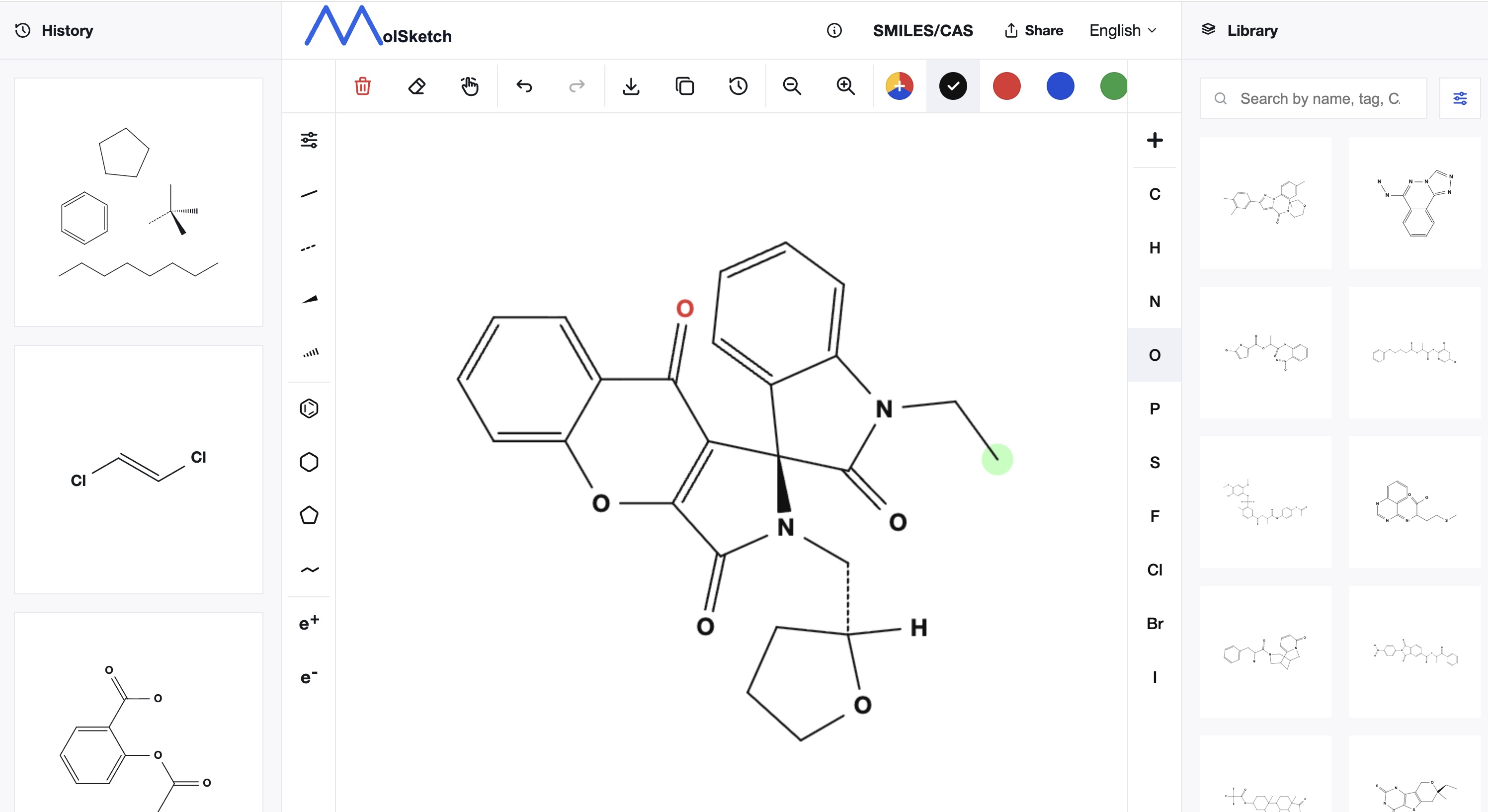
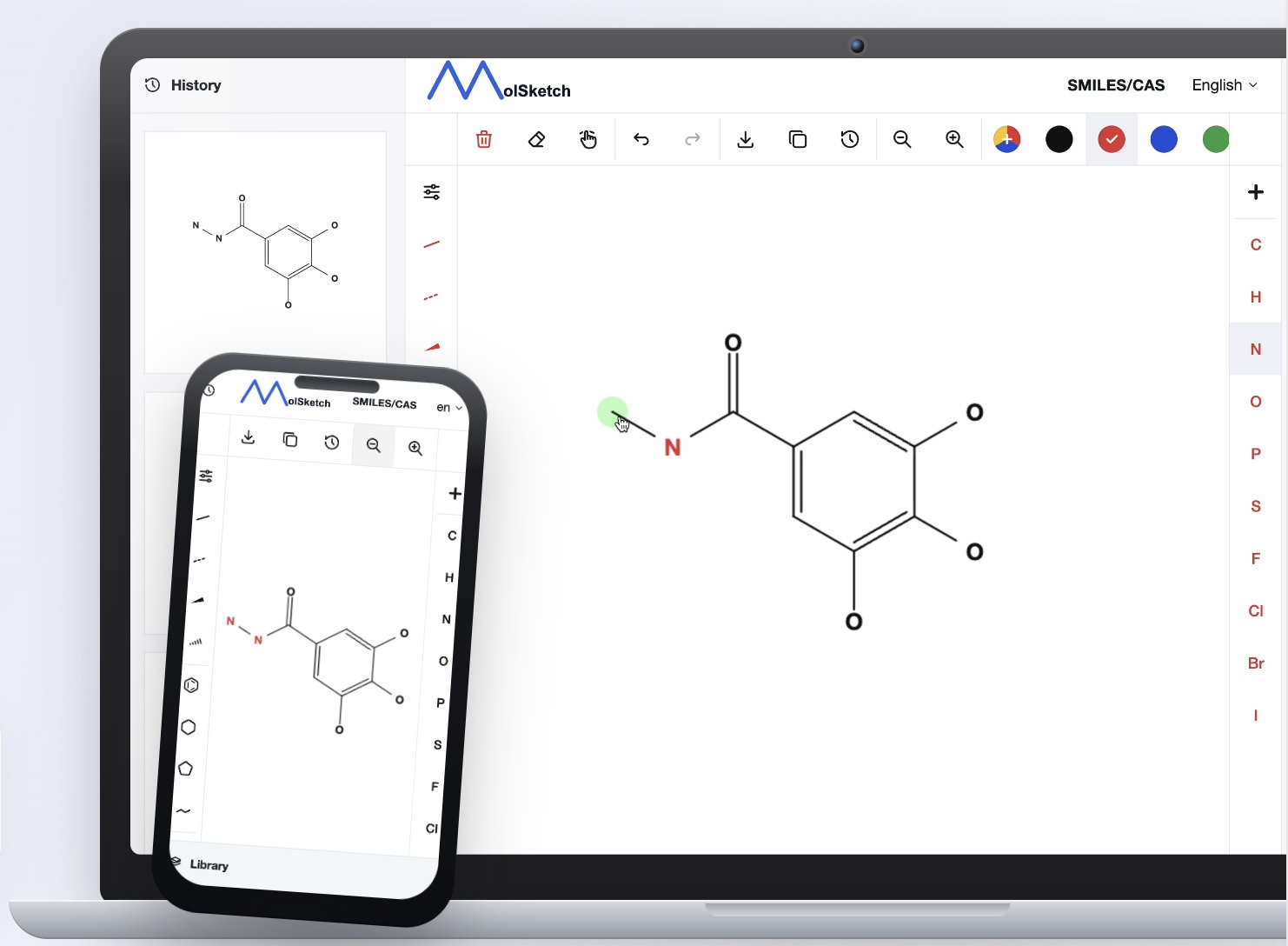
MolSketch is a free chemical structure editor that runs in the browser. No installation is required. You can create structures simply by selecting bonds and drawing on the canvas. It supports everything from nearly full structural formulas to benzene-ring templates, and the structures you draw can be exported as PNG or SVG.
If you already have a SMILES string, you can also generate a structural formula automatically just by entering it.
Summary
A chemical structural formula is a formula that shows how atoms are connected within a molecule. It supplements the information that cannot be seen from the molecular formula alone and provides clues for thinking about the properties and reactivity of compounds.
When learning structural formulas, the following points make them easier to understand.
- Look not only at the kinds of atoms, but also at how they are connected.
- Check the carbon skeleton.
- Identify the functional groups.
- Understand that molecular formulas alone cannot distinguish isomers.
- Predict properties from structure.
In organic chemistry, it is not only important to draw structural formulas. It is equally important to read them.

References
- IUPAC Gold Book, Structural formula.
- OpenStax / LibreTexts, Organic Chemistry.